
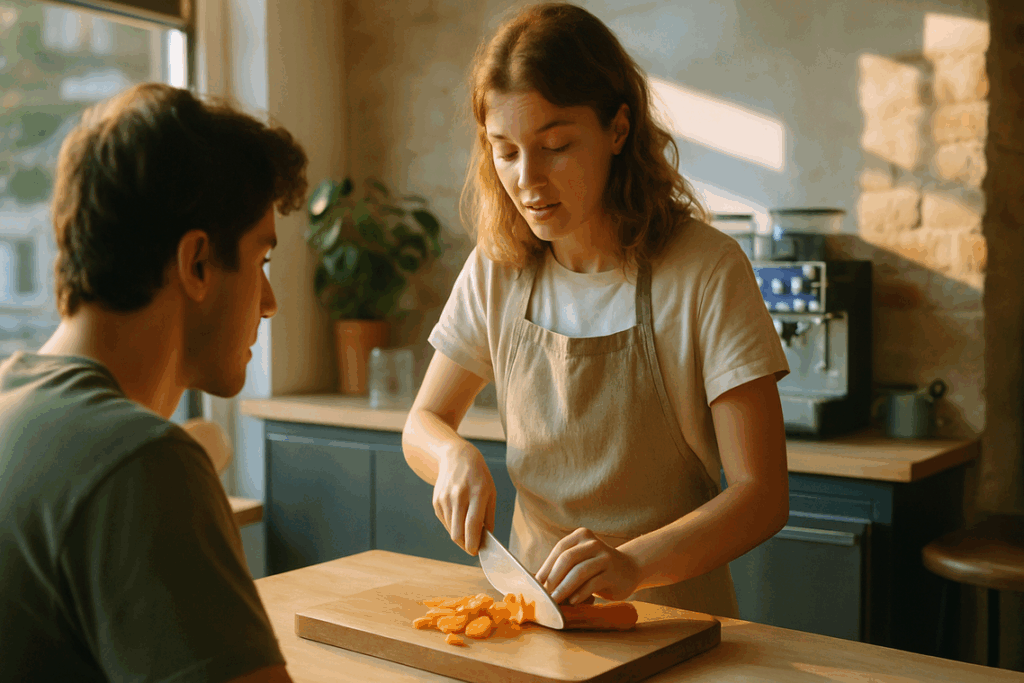
Every confident cook starts with mastering the essential knife skills that transform kitchen prep from a chore into a craft. This guide breaks down the foundational techniques that underpin great cooking, moving beyond basic chopping to precise, professional methods. Many home cooks struggle with slow prep times, uneven cuts, and safety concerns—all rooted in improper technique. Here, you’ll learn the practical fundamentals, from holding your knife correctly to executing classic cuts with control and consistency. Grounded in time-tested culinary training, these steps will immediately improve your speed, precision, and overall confidence in the kitchen.
Choosing Your Essential Kitchen Trio
Every well-equipped kitchen comes down to three blades—each with a clear role.
The Workhorse: The 8-inch Chef’s Knife
If knives were superheroes, this would be the team captain. It handles over 90% of everyday tasks, from chopping onions to slicing chicken (ask any culinary program curriculum). An 8-inch blade offers the ideal balance between control and cutting power—longer knives can feel unwieldy, shorter ones limit efficiency. When comparing A vs. B—lightweight vs. hefty—choose what feels balanced in your hand. The knife should pivot smoothly at the bolster and feel like an extension of your arm. Mastering essential knife skills starts here.
The Detailer: The Paring Knife
Chef’s knife vs. paring knife? Power vs. precision. This small blade excels at peeling, coring, and off-the-board work where finesse matters.
The Specialist: The Serrated Knife
Straight edge vs. serrated: clean slice or gentle saw. Serrations grip crusty bread or delicate tomatoes, cutting tough exteriors without crushing soft interiors. For sauce pairings, see how to build deep flavor with classic french techniques.
The Proper Hold: How to Command Your Knife with Precision and Safety
Mastering essential knife skills begins with understanding the knife itself. Three key parts shape control: the heel (the rear cutting edge, ideal for firm vegetables), the spine (the dull top that stabilizes pressure), and the bolster (the thick junction between blade and handle that adds balance). According to culinary training standards from the Culinary Institute of America, grip and balance directly influence accuracy and reduce fatigue during repetitive cuts.
The Professional Standard: The Pinch Grip
This is the GOLD STANDARD in professional kitchens.
• Rest your thumb on one side of the blade.
• Place your forefinger on the opposite side.
• Pinch just in front of the bolster.
• Wrap remaining fingers around the handle.
Why? Studies on motor control show that precision improves when force is distributed closer to the working edge. By gripping the blade—not just the handle—you increase stability and reduce slipping (think of it like choking up on a baseball bat for control).
The Guiding Hand: The Claw Grip
Your non-dominant hand does more than hold food.
Curl fingertips inward, forming a “claw.” The knuckles guide the side of the blade while shielding fingertips. This creates a physical barrier, significantly lowering cut risk. KEEP THOSE FINGERS TUCKED.
Precision isn’t flashy—but it’s what separates chaos from control.
The Core Cuts Every Cook Must Know
Mastering essential knife skills isn’t about looking flashy on a cooking show. It’s about control, consistency, and confidence (and yes, feeling a little like a pro helps).
The Rocking Chop (Mince)
This technique uses a fluid rocking motion with the tip of the knife planted on the board while the heel lifts and falls. It’s ideal for herbs and garlic. Keep your non‑knife hand resting lightly on the blade spine for stability. If someone argues a rough chop is “good enough,” they’re not wrong for rustic dishes. But a true mince distributes flavor evenly—critical in sauces, dressings, and compound butters. Recommendation: Practice slowly at first; speed comes naturally with rhythm.
The Slice
The slice is a forward-and-down motion, not a straight push. Draw the blade through the vegetable to reduce crushing. Uniform slices ensure even cooking (no one wants half-raw carrots in a stir-fry).
- Keep thickness consistent
- Let the blade do the work
- Use a claw grip for safety
Some cooks insist perfection doesn’t matter. But even slices cook at the same rate—this is kitchen physics, not fussiness.
The Dice (Small / Medium / Large)
Start by stabilizing round vegetables like onions: trim, halve, and create flat sides. Cut into planks, then sticks (julienne), then cubes. The size determines cooking speed and texture. A small dice melts into sauces; a large dice holds shape in soups. Recommendation: Choose dice size based on the dish, not habit.
The Julienne (Matchsticks)
Cut even planks, stack them, and slice into thin strips. Perfect for salads and stir-fries. Consistency ensures quick, uniform cooking.
The Chiffonade
Stack leafy greens, roll tightly, and slice into ribbons. The result? Elegant strands for garnishes or fresh salads (very restaurant-core, in the best way).
Precision isn’t about obsession. It’s about intention. And intention transforms home cooking.
Keeping Your Edge: Essential Safety and Maintenance
Have you ever wondered why chefs insist a sharp knife is actually safer? It sounds backward, right? Yet a dull blade demands more pressure, which increases the chance it will slip off an onion and onto your finger (and nobody wants that kind of drama). A sharp knife bites cleanly into food, giving you control and confidence while practicing essential knife skills.
Just as important, what are you cutting on? Glass, marble, or stone boards may look sleek; however, they quickly grind down your edge. Instead, choose wood or plastic. Your knife will thank you.
Then there’s cleaning. Do you toss yours in the dishwasher? Don’t. Heat and jostling dull and damage blades. Always hand wash and dry immediately. Store in a block, on a magnetic strip, or with a guard.
Finally, honing realigns the edge for daily upkeep, while sharpening removes metal to form a new edge periodically.
From Technique to Taste: Your Culinary Journey Forward
You came here to feel more confident in the kitchen, and now you have the foundational knowledge to handle your most important tool with control and precision. What once felt intimidating is now manageable because you understand grip, motion, and the purpose behind every cut. These essential knife skills work because they’re built on safety, efficiency, and consistency—helping you create cleaner cuts and more beautiful dishes every time.
Don’t let hesitation slow your progress. Choose one technique to focus on in your next meal and practice it with intention. Mastery begins with one deliberate slice—start today.

 There is a specific skill involved in explaining something clearly — one that is completely separate from actually knowing the subject. Christopher Pitcheristic has both. They has spent years working with tasting tips and seasonal menus in a hands-on capacity, and an equal amount of time figuring out how to translate that experience into writing that people with different backgrounds can actually absorb and use.
Christopher tends to approach complex subjects — Tasting Tips and Seasonal Menus, Gourmet Techniques and Recipes, Culinary Pulse being good examples — by starting with what the reader already knows, then building outward from there rather than dropping them in the deep end. It sounds like a small thing. In practice it makes a significant difference in whether someone finishes the article or abandons it halfway through. They is also good at knowing when to stop — a surprisingly underrated skill. Some writers bury useful information under so many caveats and qualifications that the point disappears. Christopher knows where the point is and gets there without too many detours.
The practical effect of all this is that people who read Christopher's work tend to come away actually capable of doing something with it. Not just vaguely informed — actually capable. For a writer working in tasting tips and seasonal menus, that is probably the best possible outcome, and it's the standard Christopher holds they's own work to.
There is a specific skill involved in explaining something clearly — one that is completely separate from actually knowing the subject. Christopher Pitcheristic has both. They has spent years working with tasting tips and seasonal menus in a hands-on capacity, and an equal amount of time figuring out how to translate that experience into writing that people with different backgrounds can actually absorb and use.
Christopher tends to approach complex subjects — Tasting Tips and Seasonal Menus, Gourmet Techniques and Recipes, Culinary Pulse being good examples — by starting with what the reader already knows, then building outward from there rather than dropping them in the deep end. It sounds like a small thing. In practice it makes a significant difference in whether someone finishes the article or abandons it halfway through. They is also good at knowing when to stop — a surprisingly underrated skill. Some writers bury useful information under so many caveats and qualifications that the point disappears. Christopher knows where the point is and gets there without too many detours.
The practical effect of all this is that people who read Christopher's work tend to come away actually capable of doing something with it. Not just vaguely informed — actually capable. For a writer working in tasting tips and seasonal menus, that is probably the best possible outcome, and it's the standard Christopher holds they's own work to.